

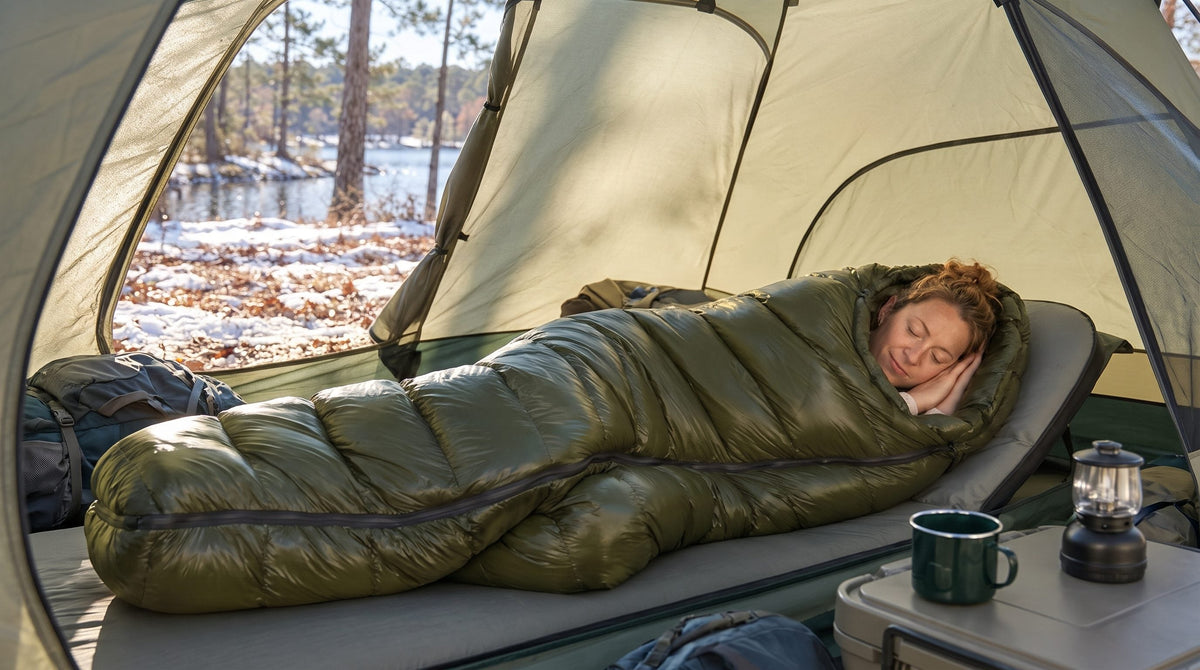
Nothing ruins a backcountry hunt, alpine trek, or late-autumn campout faster than waking up at 3:00 AM with chattering teeth and numb toes. Many campers learn the hard way that a cheap rectangular synthetic bag takes up half their pack volume yet still lets freezing drafts pour in around the shoulders. Upgrading to a purpose-built goose down winter sleeping bag solves both the weight penalty and the midnight chill, using high-loft down clusters, a 400T water-resistant nylon shell, and a roomy 80 cm mummy cut to lock in body heat down to -4°F (-20°C).

1. Down vs. Synthetic Insulation: Why Loft-to-Weight Rules the Trail
When temperatures drop below freezing, the difference between natural down clusters and synthetic polyester batting becomes unmistakable. Synthetic fibers rely on stiff, continuous plastic filaments to mimic loft. Every time you stuff a synthetic bag into a compression sack, those fibers crease and permanently lose a fraction of their insulating thickness.
Natural down works on a completely different micro-structural level:
- Three-Dimensional Thermal Trapping: Each ounce of high-loft down containsthousands of microscopic filaments that branch out in every direction, creating millions of tiny dead-air pockets that halt convective heat loss.
- Superior Compressibility: Unlike bulky synthetic rolls that hog half your backpack, a down mummy sleeping bag for adults compresses down to a compact 18 × 21 cm to 24 × 45 cm cylinder (depending on fill weight) and rebounds to full loft within minutes of unpacking.
- Multi-Year Resilience: Properly cared for, natural down retains its springy loft across seasons of heavy compression long after synthetic bags have gone flat.

❌ Bulky Synthetic Rectangular Bags
Heavy and massive in your pack → Wide, cavernous corners create cold dead-air zones → Open top collar pumps warm air out every time you roll over.
✅ Traverseon Contoured Down Mummy
High warmth-to-weight down clusters → Tapered 50 cm footbox warms feet fast → 3D cinch hood and draft tube seal warm air inside down to -4°F.
2. Six Fill Weights Explained: Match Your Bag to the Forecast (400g to 2000g)
Buying a single fixed-weight sleeping bag often leaves you sweating in July or shivering in November. Instead of guessing with vague "all-season" labels, the Traverseon system offers six exact down fill weights so you can match your thermal armor to your destination:
| Down Fill Weight | Total Bag Weight | Target Temperature Range | Ideal Camping & Field Scenario |
|---|---|---|---|
| 400g Fill | ~0.85 kg (1.87 lbs) | 15°C – 20°C (59°F – 68°F) | Ultralight summer backpacking, warm-weather huts, indoor/cabin travel |
| 600g Fill | ~1.05 kg (2.31 lbs) | 10°C – 15°C (50°F – 59°F) | Late spring & early autumn campgrounds, mild coastal nights |
| 800g Fill | ~1.25 kg (2.75 lbs) | 5°C – 10°C (41°F – 50°F) | Cool 3-season forest camping, high-desert nights, overland vehicle sleeping |
| 1000g Fill | ~1.45 kg (3.20 lbs) | 0°C – 5°C (32°F – 41°F) | Freezing autumn hunting camps, frosty mountain valleys, late October trips |
| 1200g Fill | ~1.65 kg (3.64 lbs) | -5°C – 0°C (23°F – 32°F) | True winter camping, snow-covered basecamps, unheated backcountry cabins |
| 2000g Fill | ~2.45 kg (5.40 lbs) | -20°C – -10°C (-4°F – 14°F) | Extreme sub-zero winter expeditions, high-altitude snow trenches, deep freeze |
3. Room to Move: The 80cm Wide Mummy Cut Built for Side Sleepers
The biggest complaint campers have about traditional mummy bags is the "straitjacket effect"—feeling pinned on your back with nowhere to bend your knees or tuck an elbow. Worse, if a bag is cut too narrow, pushing your knees or shoulders against the fabric compresses the down flat, creating an instant cold spot right where you press against the shell.

We engineered our 4 season down sleeping bag with a balanced 210 × 80 × 50 cm (82.7" × 31.5" × 19.7") anatomical profile:
- Expanded 80 cm (31.5") Shoulder & Torso Span: Gives broad-shouldered adults and restless side sleepers plenty of interior room to rotate, curl up, or wear an extra base layer without squashing the down chambers.
- thermally Efficient 50 cm (19.7") Footbox: Gently tapers toward the ankles so your feet don't have to waste hours heating up empty corners, keeping your toes toasted all night.
- 3D Drawstring Hood & Draft Collar: Up to 40% of body heat escapes through an uncovered head and neck. Cinching the contoured hood leaves only your nose and mouth exposed while sealing out tent drafts.
4. 400T Water-Resistant Nylon & 1.5m YKK Two-Way Zippers: Built for Real Tents
Inside a closed tent on a cold night, human breath and damp ground release up to a pint of moisture into the air. By morning, that condensation coats the inside of your tent walls. Brush your footbox or shoulder against a wet tent wall in a cheap fabric bag, and water soaks right into the insulation.
Every Traverseon down bag is armored for real-world field conditions:
- High-Density 400T Water-Resistant Nylon Shell: Tightly woven 400T ripstop nylon beads off tent-wall condensation, morning dew, and overturned water bottle spills—keeping the internal down clusters dry and lofty while remaining breathable and down-proof.
- 1.5m Two-Way Anti-Snag YKK Zipper: Built with heavy-duty two-way sliders that let you unzip just the bottom foot section to vent excess heat on milder nights without exposing your core.
- Zip-Together Double Bag System: Camping with a partner? Two Traverseon sleeping bags can be zipped together along their full-length 1.5m side zippers to create a spacious double sleeping bag—even if one person prefers a 600g bag and the other runs a warmer 1000g fill.
5. Pro Tip: Why Your Sleeping Pad R-Value Matters Just as Much as Down
Even a 2000g sub-zero down sleeping bag cannot insulate underneath your back on its own. When you lie down, your body weight crushes the soft feathers directly beneath your hips and shoulder blades down to paper-thin layers.
To get the full temperature rating out of any cold weather sleeping bag -4F, always pair your bag with an insulated sleeping pad:
- Block Ground Conduction: Frozen soil, snow, and rock drain heat 20 times faster than cold air. Use a closed-cell foam pad or an insulated air mat (R-value 4.0+ for winter) to isolate yourself from the ground.
- Shake & Loft Before Bed: Unpack your down bag 20 to 30 minutes before climbing in and give it a brisk shake. This lets the compressed down clusters expand fully and trap maximum air.
- Go to Bed Warm: Do 60 seconds of light tent stretches or sip a warm drink before zipping in. Down traps heat remarkably well, so starting with a warm core speeds up internal pre-heating by half.

Frequently Asked Questions
Which down fill weight (400g to 2000g) should I choose for my camping trip?
Always select your fill weight based on the lowest overnight temperature forecasted at your elevation, not the daytime high. Choose 400g–600g for summer and mild spring nights (50°F+); 800g–1000g for 3-season mountain camping and chilly autumn hunts (down to 32°F); and 1200g–2000g for freezing winter snow camps and sub-zero conditions (down to -4°F / -20°C).
Is a mummy sleeping bag too tight for side sleepers?
While narrow ultralight bags can feel claustrophobic, the Traverseon bag is cut with a roomy 80 cm (31.5") shoulder width and 210 cm (82.7") length. Side sleepers can comfortably bend their knees and shift positions inside the bag without feeling pinned down or flattening the surrounding down chambers.
Can two Traverseon mummy sleeping bags be zipped together into a double bag?
Yes. Using the standardized 1.5-meter two-way YKK side zippers, you can zip two compatible bags together into a single two-person sleeping bag—making it easy to share body warmth in family tents or overland setups.
Sleep Warm From Mild Summer Trails to -4°F Winter Camps
You don't need to carry a massive, bulky bedroll to stay warm when frost coats your tent fly. With six customizable down fill weights from 400g to 2000g, a weather-shedding 400T nylon shell, and a roomy 80 cm mummy cut, you can pack lighter and sleep deeper across every season.
Build Your All-Season Backcountry Sleep System
Choose your exact down fill weight from 400g to 2000g (-4°F to 45°F+), protected by a 400T water-resistant shell and a roomy 80 cm side-sleeper mummy cut.
Down Care & Field Storage Notes
- Long-Term Storage: Only use the tight compression sack while actively hiking or traveling. Between trips, store your down bag loosely in a breathable mesh sack or hung in a dry closet to preserve maximum feather loft.
- Cleaning Guidelines: Spot-clean surface dirt with a damp cloth and mild soap. If full washing is needed, hand wash gently with dedicated down-safe detergent—never wring or twist wet down clusters—and tumble dry on no/low heat with clean tennis balls to restore loft.
- Thermal Rating Note: Comfort and lower-limit temperature ratings assume the user is sleeping on an insulated ground pad (R-value 3.5 to 5.0+) and wearing a dry base layer.
Share:
Beat the Morning Freeze: Why a 12V 120W Portable Car Heater Clears Windshields Faster Than Your Engine