

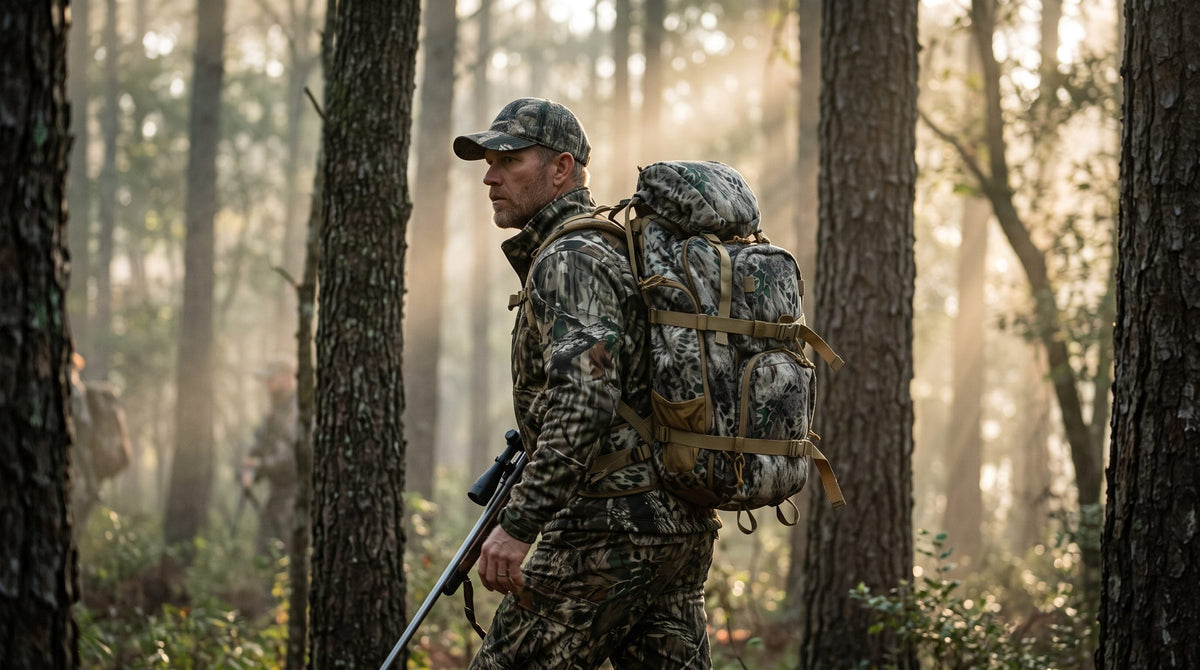
Dropping a bull elk or mule deer four miles deep in roadless timber is the ultimate backcountry rush—until reality hits. If you packed in with a flimsy daypack, you are suddenly faced with an exhausting dilemma: either destroy your lower back trying to cram raw quarters into a soft bag, or waste half a day hiking all the way back to the truck to grab a rigid pack frame. Running a purpose-built hunting backpack with frame solves this on the spot, giving you the stealth to ghost through morning timber and the backbone to haul 80+ lbs out on trip one. Here is why the old-school "two-pack compromise" is finally dead.

1. The Old Rule: Why Did We Tolerate Clunky External Frames?
Rigid external pack frames earned their reputation decades ago for a straightforward reason: they are backcountry pack mules. If you are standing on a flat gravel road with 110 pounds of boned-out bull elk, an external aluminum ladder frame transfers weight without breaking a sweat.
The problem starts the second you step off the trail and into real hunting terrain. In tight scrub oak, deadfall, and steep side-hills, rigid pack frames quickly turn against you:
- The Antler Effect (Snagging Branches): Those metal top bars stick up several inches above your head. Every dead branch and low pine bough snags the frame, jerking you backward on loose scree.
- The Creak of Death: Metal pins, cotter clips, and frame joints twist under heavy torque. When you are closing the final 50 yards on a bedded buck, a metallic squeak sounds like a flare gun in the woods.
- Torso Paralysis: A rigid ladder frame turns your spine into a straight board. You cannot bend, twist, or crouch fluidly when crawling under fallen timber.

2. The "Water Bucket" Test: The Physics of Carrying 80+ Pounds
A persistent myth among old-school hunters is that an internal frame will "taco" (buckle in the middle) the moment you load 80 pounds of meat. While that was true for flimsy weekend hiking bags from twenty years ago, modern load-hauling physics tells a completely different story.
Think about hauling a five-gallon bucket of water:
- Hugging it tight against your chest: Your spine stays vertical, your core engages naturally, and you can march uphill without agony.
- Holding it 6 inches away with straight arms: The water did not get heavier, but the lever-arm multiplies the strain on your lower lumbar discs, shoulder joints, and knees by nearly 300%.
❌ Standard Pack (Sagging Meat Lever)
Meat sinks toward the bottom rear of the bag → Pulls mass backward away from your spine → Multiplies shear strain on lumbar discs and knee joints on every downward step.
✅ Dedicated Meat Shelf (Clamped to Frame)
Meat locked directly over internal aluminum stays → Channels mass straight into your pelvic gravity line → Zero rearward pull, upright posture, and rock-steady descent.
Standard packs fail because meat sags toward the outer seams, dragging your shoulders backward and forcing you to hunch forward to fight the leverage. A purpose-engineered meat hauler backpack cures this with an expandable load shelf positioned directly between the internal aluminum stays and the main compartment.

By clamping the densest game bags flush against the rigid contour of your back, the downward force flows straight down into the heavy-duty padded hip belt. Your pelvic bone takes the load; your spine stays tall; your footing remains rock steady.
3. Timber Stealth: Why Fabric Noise Kills More Hunts Than Wind
A pack can have the strongest frame on earth, but if the fabric scratches like sandpaper against timber, you will never get within bow range. Most generic tactical bags use slick, hard-woven nylon. While durable, every brush stroke against dry chokecherry branches emits a sharp, high-frequency scratch that sends big game running over the ridge.
A true high-performance internal frame hunting backpack utilizes a specialized brushed, sound-dampening outer shell. Underneath lies an 800D tear-resistant structural weave that shrugs off rocks and briars, while the micro-brushed face deadens contact sounds. When dead oak branches scrape across your flanks in the dark, the movement stays completely silent.
4. Hands-Free Terrain Scrambling: Drop the Rifle, Grab the Poles
Navigating public land with 80+ pounds of biological weight is rarely a walk on a manicured trail. You are traversing slick grass, stepping over wet mossy logs, and picking your way down loose shale slides in the dark. Carrying a rifle or bow in one hand under that kind of load is an accident waiting to happen.
- Lower Drop-Down Boot: The rifle stock or bow lower cam seats firmly into an integrated bottom boot below the main pack volume.
- Dual Centerline Buckles: High-tensile straps cinch the barrel or bow riser dead-center against the pack's vertical backbone—zero side-to-side wobble.
- Four-Point Dynamic Balance: With both hands completely free, you can deploy dual trekking poles, distributing the brutal downhill shock away from your patellar tendons.

5. The Field Breakdown: How to Pack Out an Animal in 4 Steps
When the quartering is done, packing out should take minutes, not an engineering crisis:
- Unclip & Release: Pop the four side quick-release buckles and unzip the expansion shelf between the back panel and the main dry bag.
- Center the Densest Cut: Drop your heaviest meat bag (typically the hindquarter) directly onto the load shelf, keeping it high and centered along the aluminum spine stays.
- Cinch the Torso Axis: Buckle the horizontal load-compression straps and pull with authority until the meat bag is fused against the back panel.
- Lock the Tool & Deploy: Slide your rifle into the bottom boot, cinch the upper retention straps, grab your trekking poles, and stand up using your legs—not your back.
6. Field Matrix: External Frame vs. Soft Daypack vs. Modern Internal System
When hunters compare different hunting packs, the tradeoffs between weight, noise, and load support become clear immediately:
| Field Metric | Rigid External Frame | Frameless Soft Daypack | Modern Internal Frame (Traverseon) |
|---|---|---|---|
| Max Safe Haul Limit | 100+ lbs (Industrial) | Under 30 lbs (Buckles) | 88 lbs / 40 kg (Field-Tested) |
| Timber Maneuverability | Poor (Snags overhead limbs) | High (Agile) | Superior (Streamlined torso fit) |
| Acoustic Noise Level | High (Metal squeaks & pins) | Quiet (Soft shell) | Silent (Brushed 800D dampening) |
| Torso Flexibility | Zero (Rigid straight board) | Full flexibility | Dynamic (Flexes with lateral torso twist) |
| All-Season Utility | Meat hauling only (Leaves in truck) | Quick scouting only | One System: 41L stealth to 65.5L heavy haul |

Frequently Asked Questions
Can an internal frame hunting pack really haul an entire bull elk rear quarter?
Yes. A bone-in bull elk rear quarter weighs between 65 and 75 pounds. A dedicated pack rated for 88 lbs with dual contoured aluminum stays supports this load easily, provided the meat is strapped firmly against the frame rather than loose inside the bag.
How do I prevent blood from soaking into my sleeping bag and dry clothes?
By utilizing an independent load shelf. The meat sack sits on a dedicated heavy-duty platform separated from your main pack bag. Your clean insulation, food, tags, and electronics remain isolated inside the weather-sealed dry compartment.
Isn't a 65-liter pack too big for a quick 3-hour morning scout?
Not if it has multi-point compression. When compressed, the pack cinches flat into a sleek 41-liter profile that hugs your back. It only expands to its full 65.5-liter cavern when you unclip the shelf and pack out meat.

Stop Making the Two-Pack Compromise
You no longer have to choose between moving like an agile predator through the timber and having the structural muscle to haul out what you harvest. One well-designed internal frame pack delivers the silent maneuverability of a scouting daypack alongside the bone-carrying strength of a pack frame.
Ready to End the Two-Pack Compromise?
Engineered with internal dual-aluminum spine stays, an expandable 88 lb meat shelf, and whisper-quiet 800D fabric. Hunt light, stay silent, and pack out heavy on the very first trip.
Explore the Traverseon 65.5L Tactical Pack →Field Safety & Compliance Notes
- Firearm Safety Notice: Always confirm that firearms are completely unloaded with the action cleared and the muzzle pointed in a safe direction before mounting them into the pack's carrier boot and tightening compression straps.
- Hunter Orange Requirements: The integrated blaze-orange visibility flag provides auxiliary field identification during pack-outs. It does not replace state-mandated hunter-orange or blaze-pink clothing requirements. Always consult current local fish and wildlife regulations.
- Maximum Structural Capacity: The 40 kg (88 lb) specification indicates the pack's engineered structural load limit. Carrying comfort varies based on torso adjustment, personal conditioning, and load distribution. Always build up pack weight progressively.
Share:
Packing Out Heavy: Why Internal Frame Hunting Backpacks Rule the Timber